
A Real Estate Follow-Up System Your Sales Team Will Actually Use
Most real estate leads are not lost to competitors. They are lost between the first call and the site visit. Five simple rules for a follow-up system that sticks.
Arthaleads Team · · 8 min read
Ask any sales manager where deals are lost and the honest answer is usually the same: not at the price, not at the negotiation, but in the quiet weeks after a good first call when nobody picked the lead up again. Good real estate follow-up is what closes that gap.
Follow-up fails for ordinary reasons. The lead was in someone's notebook. The reminder was in someone's head. The note said "call back" with no date. The agent who spoke to the buyer left the company and took their phone with them. None of this is a discipline problem. It is a system problem, and a system can be fixed.
This guide sets out five rules for a real estate follow-up system that a busy sales team will actually use, a day-by-day cadence for new enquiries, what to say at each touch, and how a manager can keep it running without chasing people.
Why real estate follow-up decides who gets the booking
Property is a considered purchase. A buyer looking at a 2 BHK or 3 BHK will usually compare several projects, visit two or three sites, discuss it with family, and check loan eligibility before deciding. That takes weeks, sometimes months. The developer or broker who stays in touch, helpfully and on time, through those weeks is usually the one the buyer calls when they are ready.
Timing matters most at the very start. Research summarised in the Harvard Business Review found that companies contacting a lead within an hour were nearly seven times as likely to have a meaningful conversation as those that waited even one hour longer. After the first contact, consistency matters more than speed: the buyer should never wonder whether you have forgotten them.
Rule 1: Every lead leaves every conversation with a next date
Before you close a lead's record, set the date you will contact them again. Not "soon", not "next week", a real date. A lead without a next date is a lead you have decided to forget.
This one rule does more than any other. It turns follow-up from something people remember to do into something that appears on a list every morning. If the buyer says they will decide after Diwali, put a date in the week after Diwali. If they asked you to call on Saturday morning, set Saturday, 10 AM.
Rule 2: Work the list in a fixed order
Each morning, work in this order and do not skip ahead.
- Overdue follow-ups, oldest first. These are promises you have already broken once.
- Follow-ups due today.
- Hot leads who have shown a clear signal, such as asking for a site visit, a price sheet or a payment plan.
- New enquiries that have not been contacted yet.
New enquiries should still be answered within minutes as they arrive, ideally by an instant WhatsApp reply. The order above is for the planned calling block, so that yesterday's promises are kept before today's new leads take over the day.
Rule 3: Write the reason, not just the date
"Call back" tells tomorrow's you nothing. "Wants 3 BHK under 1.2 Cr, visiting family this weekend, call Monday after 5" lets anyone on the team pick up the conversation without starting over. Write what the buyer said, and what you promised.
A good follow-up note answers three questions:
- What does the buyer want (configuration, budget, location, timeline)?
- What is holding them back right now?
- What exactly did we promise to do or send next?
When notes are written this way, a lead can move between agents, during leave or a team change, without the buyer having to repeat themselves.
Rule 4: Decide what a "no" looks like
Many teams keep dead leads alive forever because nobody wants to close them. That clutters the list and hides the leads that matter. Agree on a clear rule: after a set number of attempts across a set number of weeks with no response, the lead is marked lost with a reason, and it comes back only through a campaign or a new enquiry.
Common lost reasons worth tracking separately:
- Bought elsewhere.
- Budget too low for any current project.
- Wrong location or configuration.
- Not reachable after repeated attempts.
- Not a genuine buyer (job seekers, vendors, wrong numbers).
Over a few months, these reasons tell marketing more than any campaign report. If half your lost leads say "budget too low", the targeting is wrong, not the sales team.
Rule 5: Review follow-ups every week
Once a week, the manager looks at one thing: how many follow-ups were due and how many were done on time, per person. Not to scold anyone, but to see where the system is leaking. If one person always has a long overdue list, they may have too many leads, not too little effort.
A simple real estate follow-up cadence for a new enquiry
Here is a cadence that works for most residential projects. Adjust the days to your market and your project; what matters is that the cadence exists and is written down.
- Day 0: reply within minutes on WhatsApp, and call if they have given a number. Confirm what they are looking for.
- Day 1: send the brochure, location pin and price range on WhatsApp if you have not already.
- Day 3: call to ask whether they have questions, and offer a site visit.
- Day 7: invite them to a site visit with two specific slots to choose from.
- Day 14: share something new, such as a construction update, a sample flat video or an offer, if you have one.
- After that: a gentle monthly touch until they answer or you close the lead.
What to say at each touch
The best follow-ups give the buyer a reason to reply. A message that only says "Sir, any update?" gives them nothing. Compare these.
- Weak: "Hello, following up on your enquiry."
- Better: "Hi Ramesh, the 3 BHK east-facing units you asked about are now down to four. Would Saturday 11 AM or Sunday 4 PM work for a site visit?"
A few habits help:
- Use the buyer's name and the project they asked about.
- Answer a question before asking one.
- Offer two concrete options instead of an open "when are you free?".
- Keep WhatsApp messages short; send details as a brochure or a link.
Our guide on replying to property enquiries on WhatsApp has more examples of first messages that get replies.
Follow-up around the site visit
The site visit is where most bookings are decided, and it needs its own follow-up rhythm. Many teams work hard to book a visit and then go quiet until the buyer turns up, or does not.
Before the visit:
- The day before: confirm the time on WhatsApp, with the location pin, the name of the person who will meet them and a number to call on arrival.
- Two hours before: a short reminder. If they cannot make it, offer the next two slots straight away rather than leaving it open.
After the visit:
- Same day: thank them, send the floor plan and price sheet for the unit they liked, and note their reaction in the lead.
- Within three days: call to answer the questions that usually come up after a family discussion, such as payment plans, loan tie-ups and possession dates.
- After a week: share something specific to their choice, such as availability in the tower they preferred.
A no-show is not a lost lead. Call the same day, assume something came up, and offer a new slot. Buyers who miss a first visit often book again when the follow-up is friendly rather than annoyed.
Calling responsibly
Follow-up should never become harassment. Call at reasonable hours, stop when a buyer clearly says no, and respect requests not to be contacted. If you run outbound calling at scale, make sure your process follows the Telecom Regulatory Authority of India (TRAI) rules on commercial communication. A buyer who feels respected is far more likely to come back when the timing is right.
Where follow-up fits in your lead management
Follow-up is one part of a wider process: capturing every enquiry, removing duplicates, giving each lead an owner and moving it through clear stages. If those earlier steps are weak, follow-up lists fill with duplicates and leads nobody owns. Our guide to real estate lead management in five steps covers the whole path from enquiry to site visit.
How Arthaleads helps
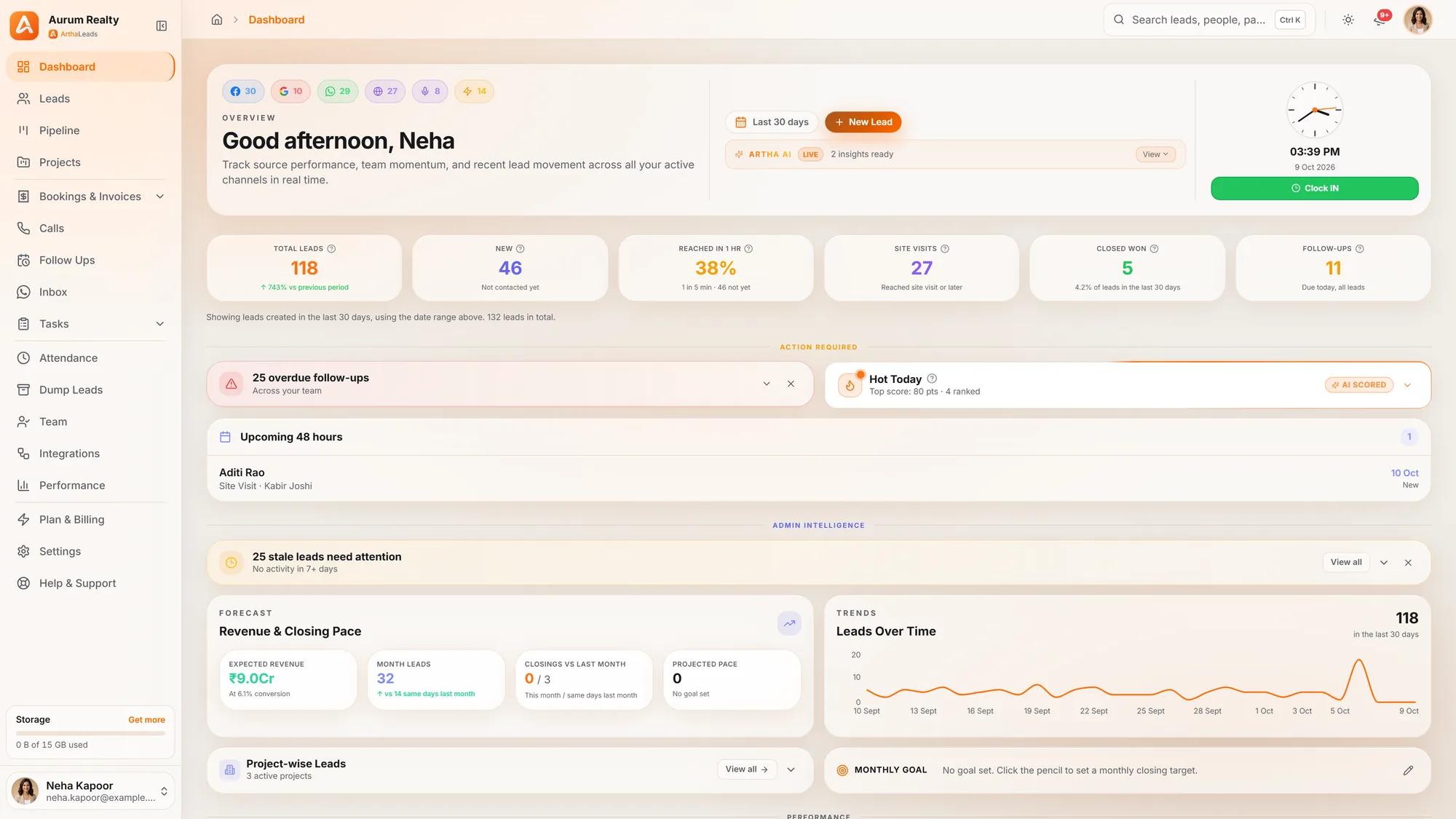
Every lead in Arthaleads carries a follow-up date and note. The Follow Ups page shows overdue items in red and today's in amber, with one-tap call and WhatsApp on every row. Your dashboard lists the overdue count and a Hot Today list that scores leads from 0 to 100 using fixed rules such as budget, recency, stage and activity, so each person knows who to call first. Push notifications on the Arthaleads Android app remind the team when a lead is assigned to them.
You can browse all features or see plans and pricing. To put a real estate follow-up system on every lead your team handles, start a free trial.
More guides on the Arthaleads blog · Arthaleads features · Pricing